We do not use cookies to make your experience better — to be honest, we use them to make our development simpler.
This banner exists because, to comply with the current e-Privacy directive, we need to ask for your consent to set cookies.
Usually companies build metres-long cookie choosers that are legal and show how laughable EU directives are. We have chosen a different path: we store no data, so you can hit Allow Cookies and no data will be stored. If you do not agree, you can hit the “x” and the same will happen — no data will be stored. If you made it this far you defy statistics, so the best choice is to leave the site; you are welcome to — you are using bandwidth someone is paying for.
Medrin is a pen name — not a CV, not a LinkedIn face, and not tied to one domain forever. We write as we. Ego posture: the less, the better. The notes currently appear mainly on ozforest.net (en). Why Medrin? While choosing the label we noticed an old medicine by that name — an antihistamine and antiemetic. The coincidence stuck as metaphor only: we want less allergy to toxic narratives, less nausea when reality will not go down smoothly, and fewer hives from watching facts get distorted into slogans. That may sound weird next to classic IT blogging. Fine — AI has already changed everything in IT that was left to change. No pharmacy, no product, no affiliation — just a useful joke we kept.
A Granada detour — Alhambra, Lorca, an Inquisition exhibition, and a flamenco night — written with an IT eye. The “overestimation of human intelligence” here points at the Inquisition. Is a disquisition about duende and mortality even possible with AI?
This note starts from the huge impact AI is having on the software labour market — without replaying Reading Obsolete. I learned Total Quality first in construction services (2000), then cooperatives and industry, heard Alberto Galgano (2009), read Qualità totale, and ask whether seniors should become quality managers instead of “conductors” — or, in current jargon, orchestrators.
AI is compressing the cost of building and maintaining software. That threatens some “coding machine” jobs — and it also reopens niche custom apps that budget once killed. A practitioner’s note for freelancers, small agencies, NGOs and organisations, with Umbraculum only as an illustrative stack example (not an endorsement). For how that can look in practice, see also the Umbraculum niche-stack field note.
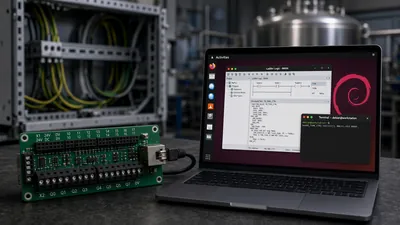
OpenPLC is open source. That is not a slogan for this brewery project — it is how we reverse-engineered the Editor project layout, the Runtime upload path, and the generated ST so AI-assisted work could stay grounded in real code. Here is what that looked like in practice.
AI in the IDE raises GDPR-shaped questions: what leaves the sandbox, who processes prompts, and when on-prem DeepSeek on EU GPU (e.g. Contabo) is the honest answer for agencies and privacy-focused merchants.
A developer’s field note (used the stack locally — not a maintainer write-up) on Umbraculum as an illustrative niche stack for native iOS/Android + web from one monorepo (Tamagui/Expo, AGPL core + MIT SDK, Cursor toolset apparatus). Not an endorsement. Companion to Niche projects as future prospect.
Garrison Lovely’s Obsolete (OR Books) frames AI as a capital project to replace human labour. Here is a practitioner’s take on the ethical stakes and the technical habits that keep AI useful without surrendering judgment.
AI authoring is useful when it sits inside a discipline: explicit rules, runnable procedures, specialist agents, and gates that refuse bad work. Here is how that looks across complex development work (Magento, PLC, ERPs, native apps) — with orchestration, analysis, and tests ahead of vibes.
For the first time in open source, I feel something chilling — that we could have surrendered our intellectual strength to the big tech giants. I could be wrong. I do not like this feeling. PhotoCraft’s “you already know” is where that doubt starts.
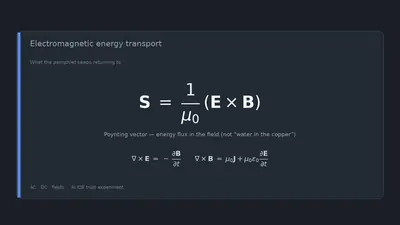
How much can you trust an AI IDE on well-known logic and technical detail when the chat context periodically resets? I answered that by forcing a pamphlet on electromagnetic fields — a domain I am not expert in — inside an unrelated PLC project workspace. The surprising part was not the fluency: it was how little context was lost when the job stayed gated and organised.
A technical companion to how we run Cursor 3 — plugins, AGENTS.md, Ansible, flows, and criteria-based testing — opened with labour-market caution (Acemoglu/Ricardo, not a sales pitch). Adaptation is survival pressure, not proof conditions improved; 5× delivery can worsen the market we already see freezing.
Govinda’s Way of the White Clouds, ethics going awry under big tech East and West, and a candid conversation with “E.” days after a Tibetan self-immolation outside the UN — why European memory of human torches still shivers, and why silence on the web unsettles me.
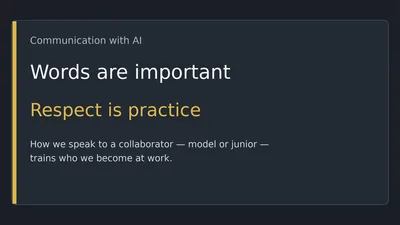
Some people address the assistant with words the like of “schiavetto” (Italian — roughly “little slave” / disposable help). Others overlay a digital whip when the answer is wrong. That is not a joke about “posture” — it is abusive language and gesture. Words are important. If someone rehearses mastery over a servant in the chat, ask how they would behave toward others when nothing stops them.
Mario Rigoni Stern’s Arboreto salvatico (Einaudi) is not a sustainability slide. He stepped back and planted trees. What depresses me is greenwashing and forgetting history — not AI itself. From the Don to Asiago, and from a living-room window onto WWI trenches.
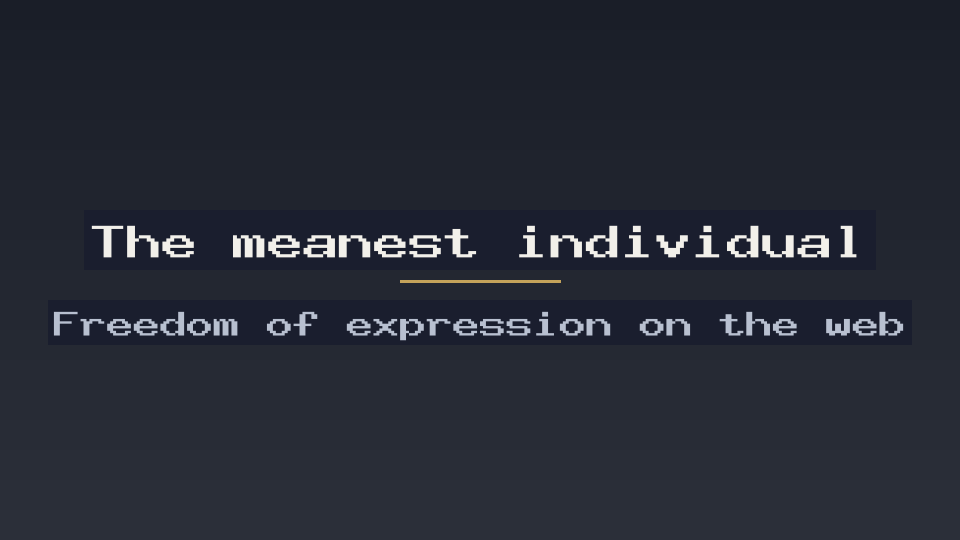
With the rise of AI I wonder if the internet’s dream of a better world is sunsetting — AI x-risk talk paired with AI as a deterrence weapon. Marat’s meanest individual, Skokie, then Germany, Scotland, Assange. Soft doubts, hard sources.