
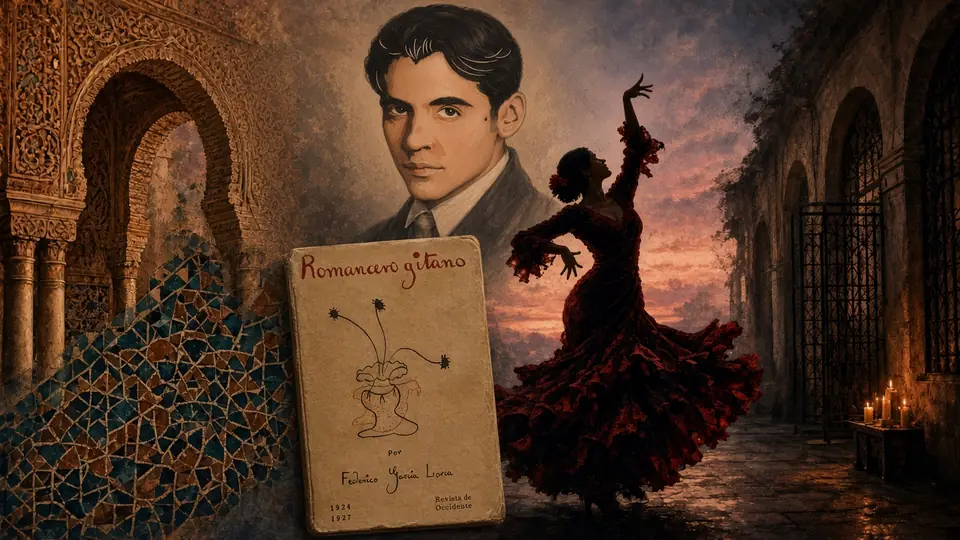
History, Inquisition and duende in Granada: an IT perspective on overestimating human intelligence
Is a Granada detour — a disquisition about duende and mortality — even possible with AI? I used an assistant to organise the journey. That is already an answer of a kind. The harder question is whether a machine can give an account of history when humans bend history for their own benefit. This note starts from the trip and lands there. The phrase overestimation of human intelligence is not a joke about models. It points at the Inquisition.
Why Granada
The past magnificence of Al-Andalus has always pulled me. Between Córdoba and Granada I chose the latter — the last Muslim polity on the Iberian Peninsula, taken in 1492 by Castile and its allies.
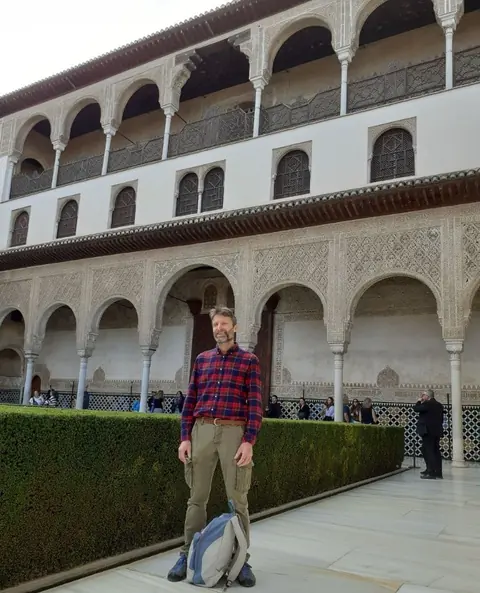
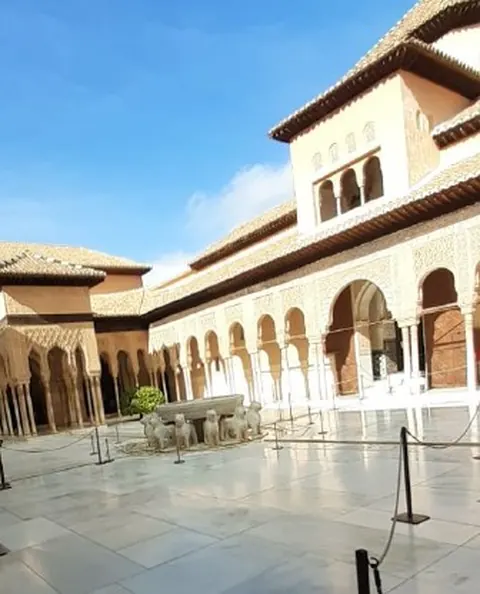
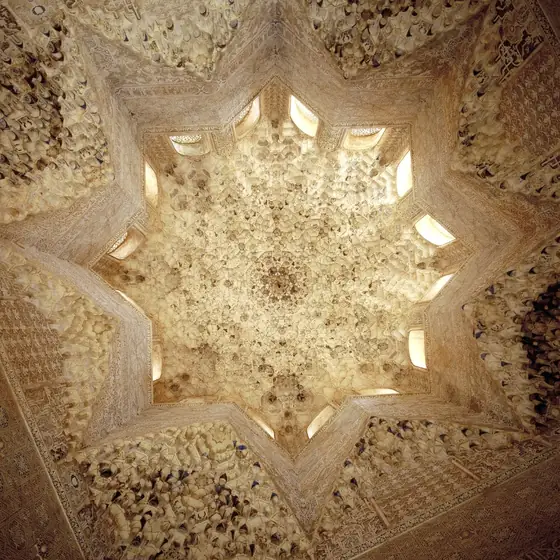
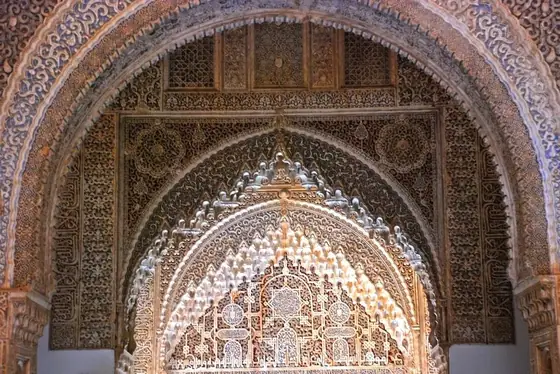
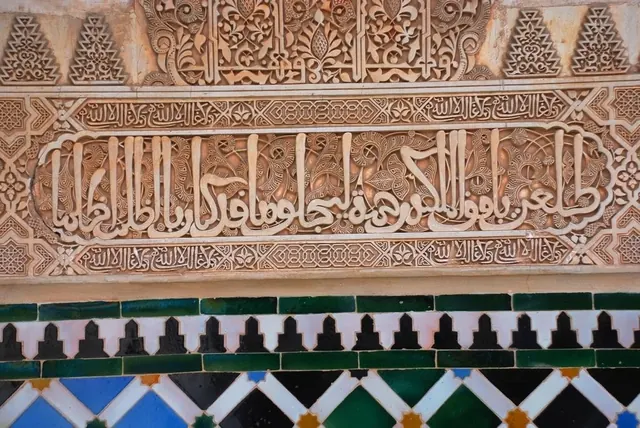
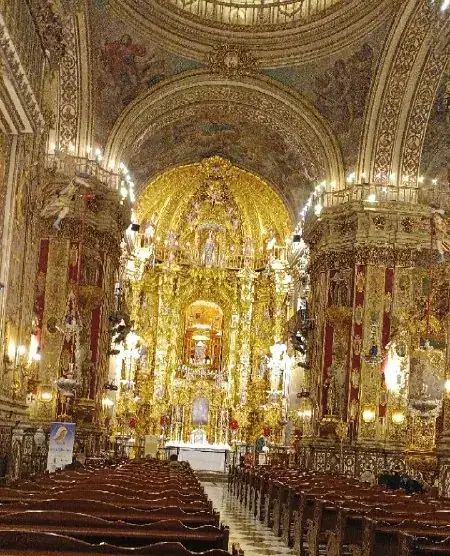
What waited in the Alhambra was above any expectation I could forecast: the Nasrid Palaces are breathtaking — slender columns, carved stucco, reflecting pools, and geometry that turns stone into lace; the Patio de los Arrayanes, the Patio de los Leones, and the muqarnas ceilings overhead stay in the eye long after you leave. Christian Granada was of the greatest magnitude of beauty as well — above all the baroque basilica of San Juan de Dios, raised beside the work of the Hermanos Hospitalarios (Orden Hospitalaria de San Juan de Dios). Juan Ciudad — later Saint John of God — founded his first hospitals in Granada in the 1530s for the sick and the abandoned poor; the brothers’ mission of hospitalidad is still the care of the vulnerable, and the gilded nave sits next to that older vocation of building hospitals for those who had nowhere else to go.
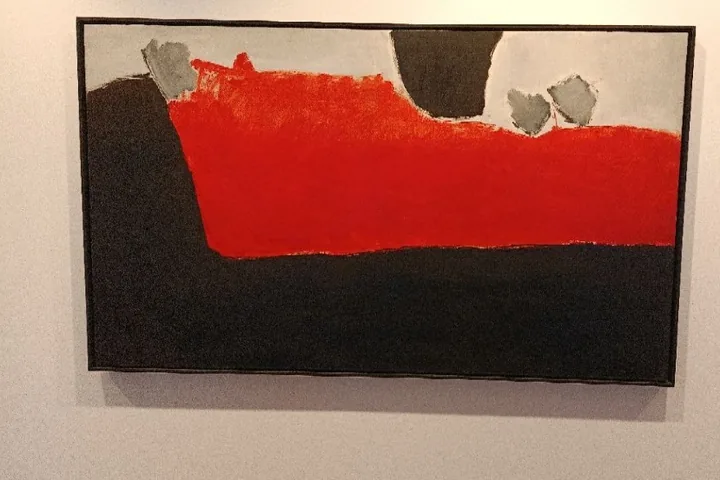
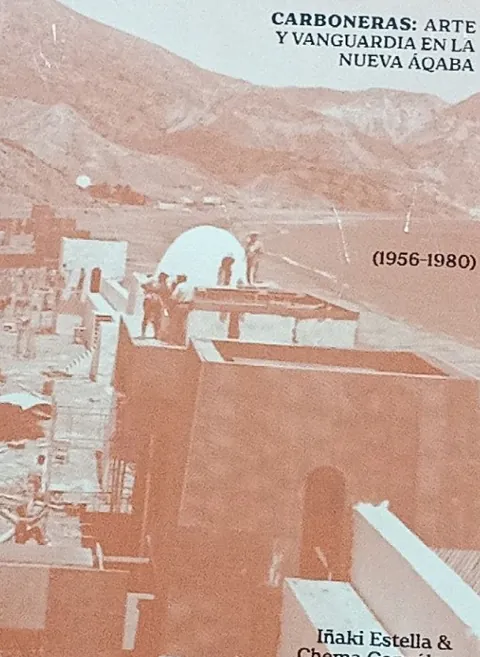
A contemporary exhibition of the Carboneras was unexpected and strangely interesting.
I had already met Granada through Washington Irving — first Tales of the Alhambra (often titled simply The Alhambra), then his earlier A Chronicle of the Conquest of Granada. In the Alhambra book he names the Renaissance pile of Charles V for what it does to the citadel: some historians argue that much of the Oriental winter palace was even demolished to make way for it (as far as I know this hasn’t been securely established), and Irving and his companions “regarded it as an arrogant intruder,” passing “with a feeling almost of scorn” toward the Moslem portal. The building might have architectural merit elsewhere; inside this hill it should have stayed out. The same pages define what he loved in Arab Spain’s culture: the Alhambra as “a rugged fortress without, a voluptuous palace within,” with “poetry breathing throughout the fairy architecture of its halls,” and Moslem Spain as “a region of light” where a warrior power outside coexisted with “a realm devoted to literature, science, and the arts.” That is closer to what the Nasrid rooms still argue than any guidebook summary. That said, let’s be aware Irving was writing during what we now call the Romantic period: that does not, in my opinion, take any merit from his architectural notes. About Moslem Spain as “a region of light,” though, the claim is a bit too stretched: Al-Andalus was also a politically unstable world of dynastic struggles, warfare, social hierarchies and considerable political intrigue. And let’s not forget where the Moorish world sat: we cannot imagine that all the cultural achievements Irving describes were uniquely Moorish. They emerged from a rich Mediterranean world of exchange involving Arab, Byzantine, Persian, North African, Jewish and Christian traditions. None of that takes anything from the breathtaking beauty of the Alhambra: acknowledging those complexities does not diminish the achievements or the beauty. I cite Irving here as my starting point for knowing the Alhambra before the visit — not as a finished historical verdict.
In a tetería I drank two of the best black teas I have tasted: the Egyptian and the Persian: both with mint, they were very refreshing. I did not explore the Albaicín properly — only a couple of crossings. Casa del Chapiz and El Bañuelo were both closed when I arrived, so I could only see them from outside. Sacromonte and its Gitano history stayed out of reach: a heavy rain and too little daylight left before evening. Next time that hill is the priority.
The unplanned last day still wrapped the journey: the home of Federico García Lorca (where I bought a Spanish Romancero gitano), then the Palacio de los Olvidados — Inquisition exhibition, Lorca Infinito, and a flamenco performance under the same roof. That sequence is the spine of this note. I also enjoyed a coffee in the friendly atmosphere of the Hotel Reina Cristina — at the time of Lorca’s last days of freedom, that building was the house of the Rosales family, where he took refuge before his arrest in August 1936.
The Inquisition rooms
The exhibition of Inquisition instruments of torture sat in the Palacio de los Olvidados, in the lower Albaicín, by the Darro river, at the foot of the Alhambra. As I have already mentioned briefly, the building stacks several worlds: on the ground floor the Palacio Flamenco; on the second and third floors the Inquisition rooms; on the top floor the exhibition Lorca Infinito. That Spanish Inquisition exhibition deserves a few lines in memory of the men and women who suffered immense and unjust pain there. I grew up where Fra Dolcino taught, not far from where Margherita grew up, and in the valley of Fra Alberto da Cimego. I cannot pretend this history does not haunt me sometimes.
The rooms show suffering imposed by the Church — and they remind you that reigning kings used the same apparatuses for what they called the crime of lèse-majesté. There was no justice in that system: no need of fair process, no honest accusation, only dishuman pain inflicted on people whose “crime” was often simply trying to live. In the witchcraft hunts, the accusation against a woman could be as ignoble as living with another woman, or being a single mother. Inflicting atrocious suffering on innocents is a crime against humanity. I will not describe the tools. I spare you that.
One more landing: the Church was a devilish institution in that hour, but the states — Spain, Venice, and others — were partners in the crime. That does not reduce the Church’s key role. It should land clearly in history. When I write about an overestimation of human intelligence, this is what I mean: the arrogance of a system that believed it could purify truth with fire and iron, and called the result order.
Hemingway’s Spain, an empty plaza
I owe Hemingway much of my early reading of Spain — For Whom the Bell Tolls, Fiesta — and the only serious reading I had about the corrida, Death in the Afternoon (often called the first major book on bullfighting written in English by a foreigner). In November the Plaza de Toros had no fights on the schedule. That empty calendar was fine. The aesthetic of the ring still walked into the night another way.
Flamenco, Gitano, Lorca, duende
Flamenco is not simply “Gitano music,” and not all Gitano music is flamenco. It is an Andalusian art in which Roma artists have carried an extraordinary weight — song (cante), guitar (toque), dance (baile) — with duende as the force that is hard to translate: intensity that is not technique alone. Lorca heard that world and made literature of it: Romancero gitano, Poema del cante jondo, the Concurso de Cante Jondo with Manuel de Falla in 1922. He was murdered near Granada in August 1936. Visiting his house is not only a literary stop. It is a political wound.
Lorca’s vision held the popular and the tragic together. He did not treat Gitano song, Andalusian landscape, erotic desire, or death as raw material to be cleaned up for a respectable culture or a political programme. He listened to cante jondo as a truth of the body and of loss — beauty that refuses the comfort of a purifying ideology, whether clerical or fascist. That made him dangerous in July–August 1936, when the military rising against the Republic opened the Spanish Civil War (1936–1939). Nationalist militias — squads of the Falange (Spain’s fascist party), Civil Guard units, and other armed groups of the military rising against the Republic — killed him near Granada: for his Republican leanings, his homosexuality, and the cultural authority of a poet who sided with the living poor rather than with “order.” His legacy is the poems and plays, and also the open grave of a country that still argues over memory. The war split Spain between a fractured Republic — not a single clean banner: Popular Front institutions, Soviet-aligned Communists, and a brief, fierce anarchist social revolution in places such as Catalonia and Aragón (a radical social experiment of hope and mutual aid). Across that wider Republican camp there was also anticlerical violence, party score-settling and authoritarian habits — and a Nationalist camp that was Spain’s fascist side of the war: the Falange, the rebel army, and the clerical right, backed by Fascist Italy and Nazi Germany. Mussolini’s Corpo Truppe Volontarie was far more than a few aircraft: over the war Italy sent on the order of 70,000–80,000 military personnel, hundreds of planes, tanks and artillery, naval support, and money and logistics. Italian units fought in major operations; their defeat at Guadalajara in 1937 showed the limits of that expedition even while the overall Italian stake remained decisive. Nazi Germany’s Condor Legion supplied the air terror that made Guernica a byword. I name the Italian contribution at that scale because it is part of our history — like it or not — not a foreign footnote behind German bombers. Franco’s victory installed a fascist dictatorship; after 1945 it shed the Axis uniforms but kept a long authoritarian regime until his death in 1975. The wound did not close with the Transition. Two English books I carried with me when I read Spain were George Orwell’s Homage to Catalonia — the war as he fought and saw it among the militias — and Animal Farm, a parody of Stalinist communism: the fable of a revolution that eats its own promise. That insight is not abstract. In Spain the Communist apparatus could send anarchist columns to bleed at the front (as at Huesca) and then help crush them in Catalonia rather than fight the fascists alongside them — the May 1937 events in Barcelona that Orwell recorded. I also read Lev Trotsky’s History of the Russian Revolution (Storia della rivoluzione russa): many still call it the best book on 1917, and as history it is formidable; yet the contempt for anarchists seeps through the page. Granada’s flamenco night and Lorca’s house sit inside that same unfinished history.
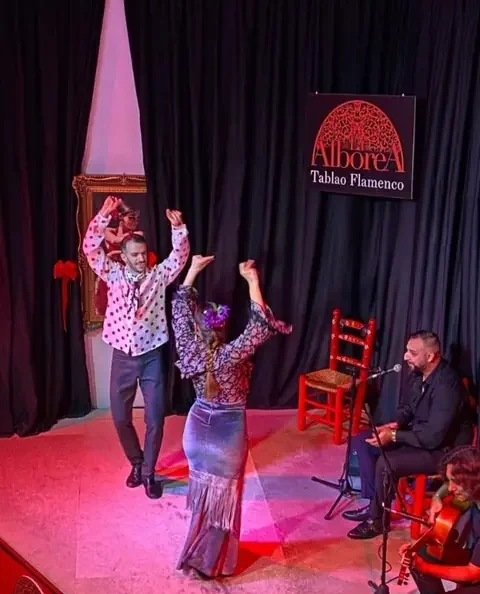
The performance I saw had four people: male and female dancers, a male singer, a male guitarist. The dancers worked largely alone — passionate, quick footwork that numbs the floor (zapateado), then sudden stillness. Sometimes they seemed near catharsis. That is the word I had before I reached for Lorca’s duende.
In the male dancer’s last piece the female dancer shouted something I first heard as “oè toro.” ¡Olé! was present all evening; in that last dance it was clearly ¡Olé, torero! He took off his jacket and used it — in my reading — as a cape: aesthetic figures that borrow the visual language of the bullfight without becoming a literal imitation. Flamenco absorbs Andalusian life and turns it into its own tongue. After Lorca’s house, that night did not feel like tourist folklore. It felt like the same cultural story continuing without a lecture.
Flamenco and the Gitano line also feed music I love outside the tablao. As a rock listener I am fond of the Eagles’ “Hotel California,” and one cover I return to is the Gipsy Kings’ Spanish version: it keeps the melancholy of the original, adds Spanish words, and carries the song on a nylon-string flamenco guitar — the same instrument family as flamenco toque. The group has been fronted for years by the songwriters and producers Nicolas Reyes and Tonino Baliardo. Nicolas’s father, Jose Reyes, formed a celebrated flamenco duo with Manitas de Plata that counted the likes of Miles Davis and Pablo Picasso among its fans. When that pair parted ways, Reyes grew still more popular with his own band, backed by his sons and called Los Reyes — the family root from which the Gipsy Kings later grew.
Where software and AI land
On one hand I used AI to organise a cultural journey. That brings a practical lesson I already live in the IDE — and that I wrote down in How I write code with Cursor: context matters. How you arrange the project — folders, notes, what the model can “see” — changes what you get, for a trip as for a Magento module. Organisation is not bureaucracy. It is the condition under which an assistant becomes useful instead of noisy.
On the other hand: how can AI give an account of history if history is often bent by humans as well? Recent Italian historiography work around Wikipedia and public memory — I think of the Nicoletta Bourbaki investigations — makes that question less abstract. That collective does methodical, source-based work on how entries and public narratives get steered: not a conspiracy slogan, but the slow craft of checking citations, timelines, and political framing. I read La morte, la fanciulla e l’orco rosso (Death, the Maiden and the Red Ogre) and I advise anyone who wants to see how history can be bent by subtle political interests to read it. Next to that sits scientific journalism — reporting that treats documents, data, and reproducible method as the spine of the story, not as decoration after the angle is chosen. WikiLeaks belongs in the same family of pressure on the narrative: when primary cables and files are published, the public can test claims against sources instead of swallowing a cleaned account.
I am not yet clear whether AI’s role in that ecosystem will lean positive or negative. I will not pretend a trip note settles that. I only refuse the lazy comfort that a fluent summary is the same as a witnessed past.
The core of this note is an IT perspective on the overestimation of human intelligence. Much of the anger aimed at AI, I think, is inflamed by the word itself: intelligence. If the same systems had carried a colder label — say “data modelling” (a made-up stand-in to show what I mean, not a rename I am proposing; I firmly think the name should not change) — we would have heard less outcry. That does not dissolve the fight. Even under a neutral label, everything described in Reading Obsolete: ethics and craft in an AI labour race would still be real and urgent: fraud, surveillance, deskilling, energy cost, labour leverage. What strikes me is that humans — and especially developers — may now see a privilege at risk: first of all the privilege of writing code. I do believe it is a privilege. Other sectors have already been hit by labour crisis — as I already wrote in that Obsolete piece (Ricardo is one case; many recent examples could be cited) — and the software community, as a community, never moved a finger for them. So a large part of the developer outcry toward AI is, provocatively and on purpose, a bourgeois outcry: many developers simply fear losing money.
There is another, more interesting side of the coin. Voices such as nixCraft — I name them because they know the field, carry authority on their own terms, and try to move the AI discourse, which is positive — may, without quite saying so, fear losing something that defines them as human beings: a planetary monopoly on the definition of intelligence. Human beings do not seriously grant “intelligence” to any other being on Earth. And here Granada returns the question: intelligence — really? Go through the Inquisition rooms. Read Lorca’s story. Read more history. History is largely a story of the powerful crushing the poor. Waiting for a delayed flight in Málaga airport last night I listened to a podcast on Rosa Luxemburg and the Spartacist revolt; she wrote What Does the Spartacus League Want? (Was will der Spartakusbund?), and she was summarily killed by the Freikorps for beliefs aimed at a fairer humanity — whether one shares those beliefs is beside the point. I read her with interest because dreaming of a better humanity (even if it is not possible; I agree with many readers that the law of the strong will probably prevail) is something I am not ashamed of. But again: is “AI intelligence” really the point — or are we overestimating human intelligence? Look only at the highest human achievements and perhaps we are not. Then again: is the atomic bomb not one of those highest achievements?
Closing
Granada holds overlapping worlds: Al-Andalus in the Alhambra, the Gitano and Andalusian voice in flamenco, Lorca’s art, and the political trauma of the Civil War. They do not stay in separate museum rooms. After that last day I do not need a slogan about AI and culture.
That is what I brought home from Granada — a presence of the once flourishing Moorish world on the Iberian Peninsula that still carries some of the finest artworks I have seen so far in my life, their great love of water and gardens, the fine arts and the sciences; flavours and perfume of tea mint still somehow present, Romancero gitano in Spanish in the bag, and a clearer name for the overestimation I meant.
Written with the help of an AI assistant.